
FIVE SHILLINGS MONO-COLOUR POSTAGE DUE STAMP
AN ANALYSIS OF THE AUSTRALIAN PROVISIONAL ISSUE (better known as the ‘BLANK BASE’ issue) of the FIVE SHILLINGS MONO-COLOUR POSTAGE DUE STAMP.
This commentary provides a more comprehensive listing, than currently available, of flaws/faults/varieties (hereafter referred to as “flaws”) on the Australian blank base 5/- postage due stamp.
It assumes the user is familiar with:
- the use of Australian postage due stamps, first in the States of NSW and Victoria and, after Federation, in the other Australian States;
- the fact that the provisional Australian issue was derived from a modification of NSW postage due stamp printing plates used between 1891 and 1902;
- that the provisional issue was on use from July 1902, but the blank issue stamps were generally not used in NSW (who continued to use their own pre-federation postage due stamps) or in Victoria, which also continued to use their own pre-federation postage due stamps;
- that the following denominations comprised the provisional/blank base range of Australia’s first postage due stamps – 1/2d, 1d, 2d, 3d, 4d, 6d, 8d and 5/- ie denominations of one halfpenny, one penny, two pence, three pence, four pence, six pence, eight pence and five shillings;
- that each denomination was printed in sheets of 120 stamps, with the sheet divided into 2 panes of 60 stamps each, with each pane consisting of 10 rows of 6 stamps per row;
- of the method of producing the dies for each printing plate whereby some flaws would repeat themselves in different individual stamp dies;
- the printing of stamps using dies, printing plates and ink;
- that the Australia blank base print dies were ‘recycled’ from the NSW dies by the hand removal (chiseling) of the letters ‘N.S.W.’ from the NSW 1891 dies (the resulting blank base stamps merely had a ‘blank’ where the NSW letters had been removed); and
the following ‘type of flaw’ classification (1):
- Die flaws– occurring in every stamp in the sheet
- Primary flaws – occurring in every stamp in each column
- Secondary flaws – occurring once in each group or electro of 30, always in the same relative position
- Tertiary flaws – due to plate damage and occurring once only on each sheet of 120
- Quaternary flaws – occurring in virtually every stamp on the sheet of 120 resulting from the removal of the letters NSW by hand.
(1) R. P. Hyeronimus, Commonwealth of Australia: The Postage Due Stamps 1902 – 1963, Hawthorn Press, Melbourne, 1980.
A scan of the NSW 5/- postage due and Australian 5/- blank base postage due stamps is reproduced below.
It can be seen that the colour of the stamps differ. In Section 10 of the Australian Commonwealth Specialists’ Catalogue (2) the NSW stamp colour is described as ‘Dull Green’ and the Australian stamp as a far sexier ‘Emerald’.
(2) Geoffrey Kellow, Editor, “Postage Dues including NSW and Victoria”, Brusden-White, Broadway, NSW, 2020 (which I will refer to as BW 2020).

Identification of Additional Flaws in the Australian 5/- Postage Due Stamp BW 2020 D11
Only 1 blank base 5/- stamp is listed in BW 2020, under the identifier of BW 2020 D11.
Three different NSW 5/- postage due stamps are listed in BW 2020 – ND 33, ND 34 and ND 35 (as a result of 3 different perforation combinations). No flaws are listed for these stamps. However, as can be seen on stamp 1 for the NSW block of 4, there is a clear flaw, which also occurs in the Australian printing where it is described as “BW D11d – White scratch through oval to lower part of 5”. More on this flaw later.
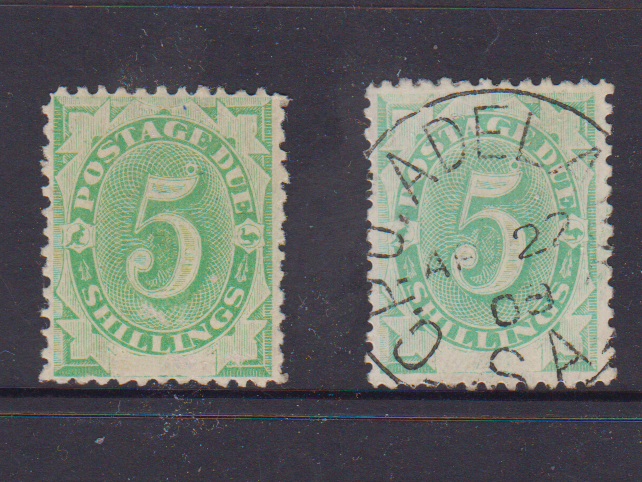
Flaw 1
“Bullet Hole” circular dot flaw on the top right of the number 5.
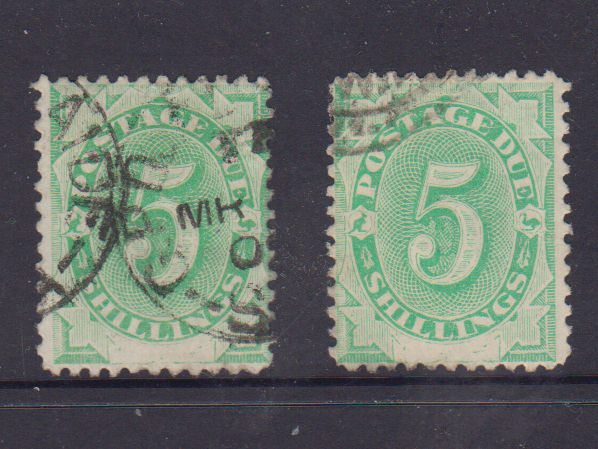
Flaw 2
Scratch through “AGE” of POSTAGE
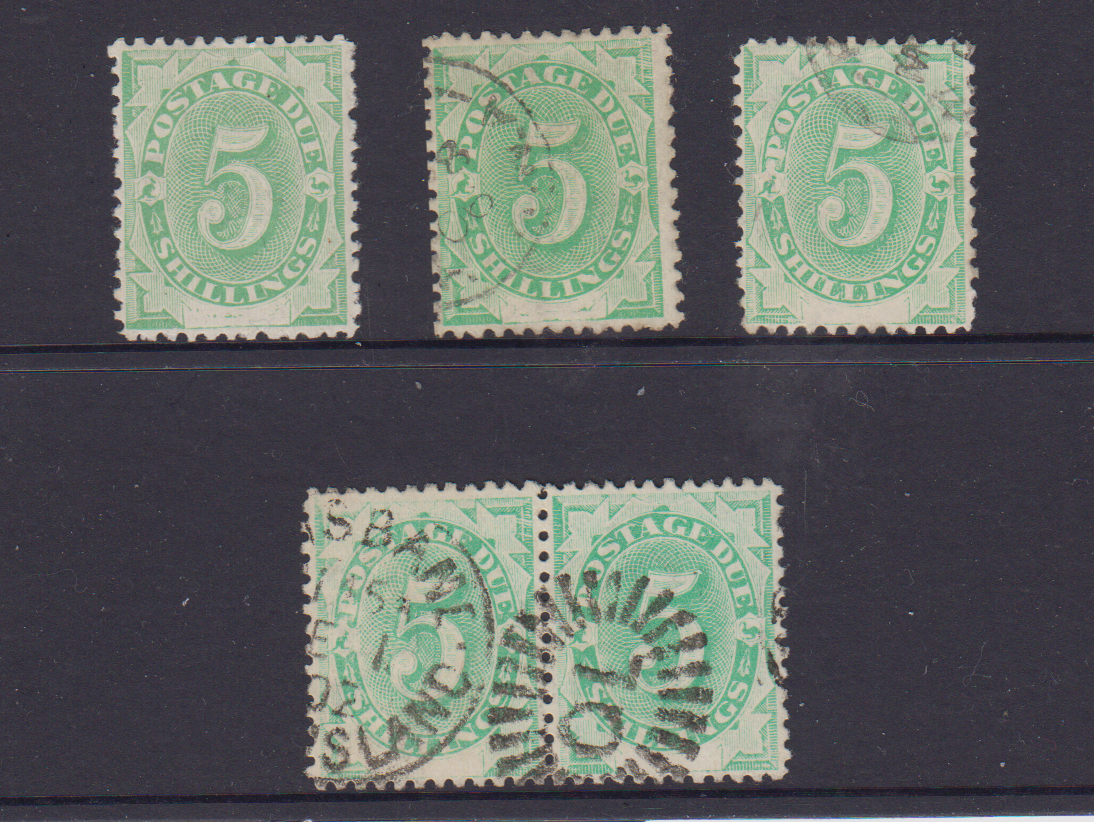
Flaw 3
The “Wild” scratch on the top right corner
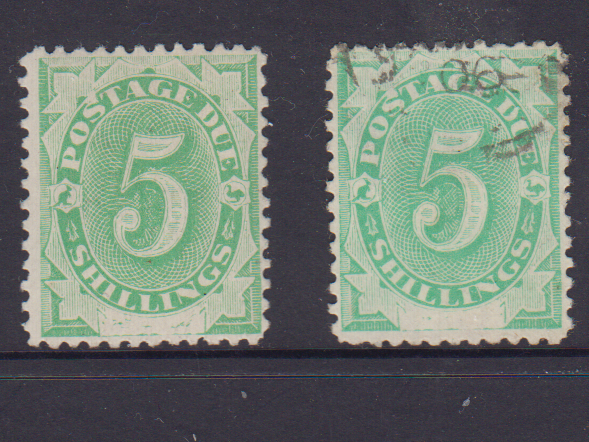
Flaw 4
White flaw on top of S of POSTAGE
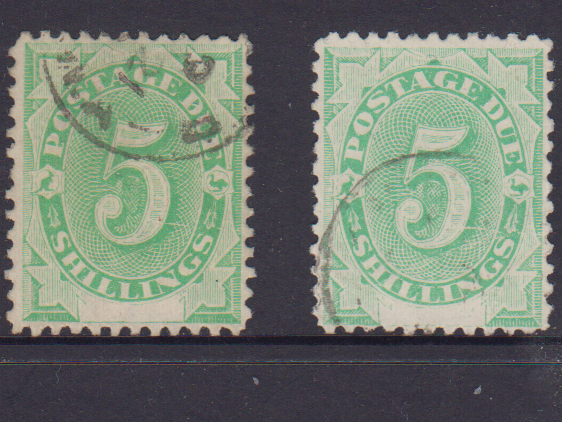
Flaw 5
White scratch through oval to lower part of “5”
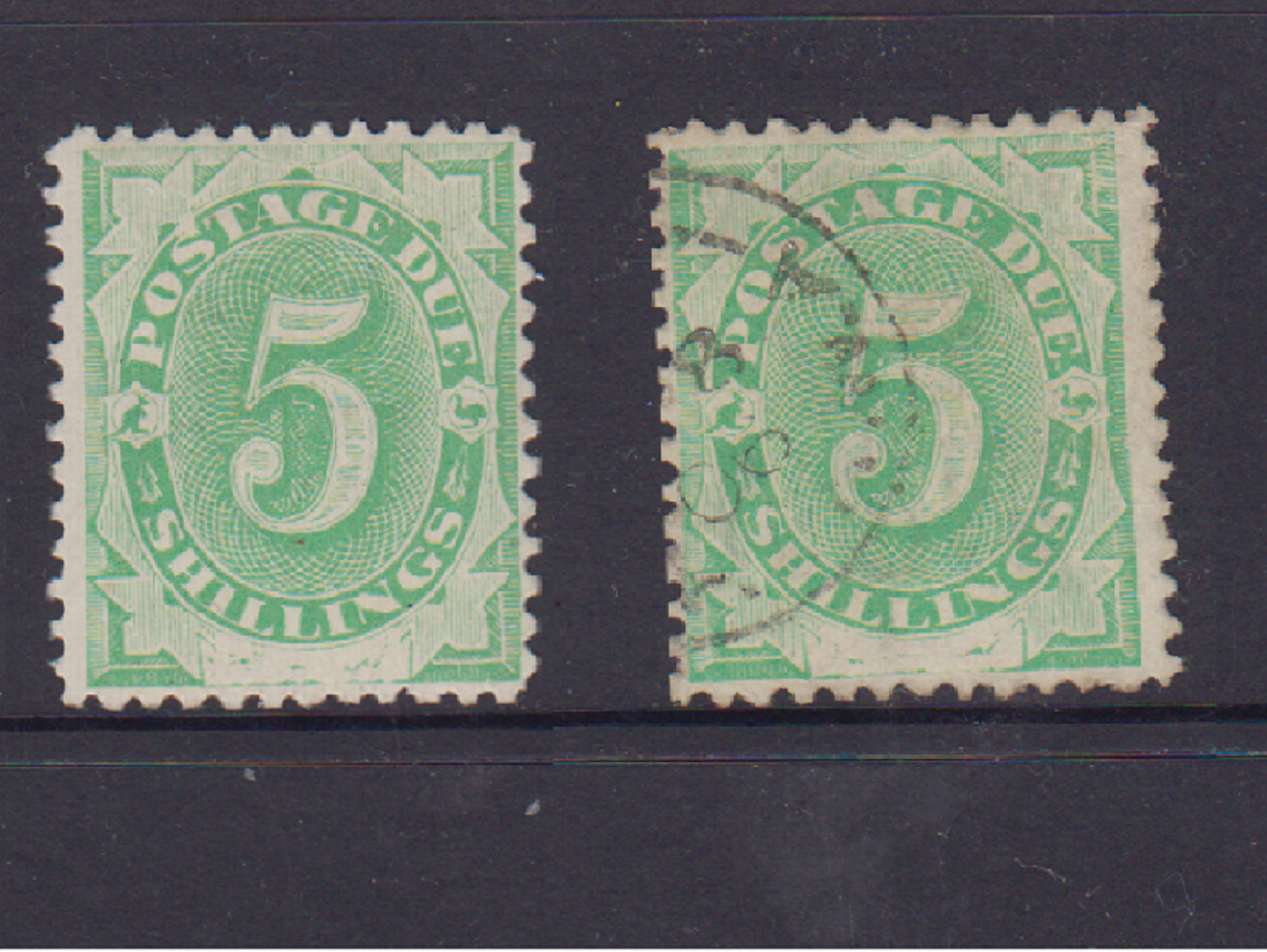
Flaw 6
Portions of letters of “N.S.W.” showing
Final Words
As is the way of these blank frame NSW converted Postage Due issues, there is a range of smaller flaws on other stamps that I hold, but because of their relative insignificance compared to the above flaws, or because I don’t have more than I example of the flaw, I have not attempted to list them here.
I am ever aware of the Hyeronimus claim that, because of general wear and tear on the printing plates over the decade since they were first assembled (which even in the assembly process produced flaws) and the damage caused by the chiseling off of the NSW letters that, with enough magnification and imagination, each of the 120 stamps in a sheet will exhibit at least 1 unique feature.
Hyeronimus avoided the problem neatly in a comment on the 8d and 5/- blank stamps:
“Primary, secondary and tertiary flaws undoubtedly exist but insufficient material has been available to carry out adequate research.”
Well Mr Hyeronimus, I have made a start.
About John
John Maclean is a passionate stamp collector, with a particular interest in postage due stamps.
 Postage Due Stamps